
Classification … PEACEFULNESS > #MIND, #HOWTO, #REPROGRAMMING, #HEALTH … (FULL-SYSTEM)
Overview … EFT is a fast-acting mind-body technique that reduces emotional and physical problems by tapping on acupuncture points while focusing on the issue, lab-proven effective for producing rapid relief, and so simple anyone can do it.
<Adapted from “EFT: The People’s Therapy?” at The Stage Door, Mount Shasta>

What if …
What if you had a simple, fast-acting way to clear emotional problems, increase your performance in sports or speaking or writing, escape chronic pains and insomnia and migraines, cravings for the wrong foods, compulsive behaviors, phobias, and even severe difficulties like PTSD?
Imagine helping yourself—or your loved ones—to attain relief like this … and what if you could learn how to do it very quickly, so that you always had this skill on hand, at any time, at any place?
If that sounds good, read on. Because all this has been research-tested and proven to work, and it’s estimated that 10 million people worldwide have used this method in their daily lives.
What is the Emotional Freedom Technique?
The “Emotional Freedom Technique” (EFT) is a method whose purpose is to free one from both physical and emotional pain. The process consists of identifying problems, and then tapping certain points on the body, with the result that many difficult-to-handle problems of mind or body can be improved or completely alleviated.
If that sounds too simple, hang on, because by the end of this article, you’ll be able to do this yourself, and you’ll have a toolkit of ways to expand it to projects like removing limiting beliefs, improving money issues, increasing your energy, manifesting more of the life you want, and even helping your pets.
It’s fast and it’s free, and it doesn’t matter whether you “believe” in it or not. Try it and watch it work.
Quick History
It began with a woman named Maria, who suffered from a crippling fear of water. Her therapist, a Dr. Roger Callahan, worked with her for over eight months, and he tried every method he knew to cure her. But nothing worked at all.
By chance, Callahan had been reading about “meridians” (lines running through the body, used in Chinese acupuncture). These are said to affect our health, and with very little thought, he tried tapping on a point below Maria’s eye, which is the end point of the “stomach meridian,” because she’d mentioned an upset stomach, and he thought it might possibly help.
And she suddenly announced to Dr. Callahan that her phobia had … vanished. And to prove it, she went down to a local pool, and began splashing water on her face, laughing.
The headaches, the panic attacks, and the fear were gone. She no longer had the bad dreams and nightmares that haunted her for years.
Since then, EFT has proven—in over a hundred clinical research studies, in practice by millions of people, and in countless case studies—to deliver a “breakthrough” when all else had failed.
Enter Gary Craig
Craig, a Stanford-educated engineer, who attended on a football scholarship despite being undersized, had done very well in the insurance and investments field after college, and he’d also developed an interest in self-improvement, performance psychology, and personal growth. As it happened, his training in engineering and in business made him prone to streamlining complex systems.
And in 1991, he became a student of Dr. Callahan, who was now the founder of Thought Field Therapy (TFT). It was a powerful but complicated system, with multiple tapping sequences and different acupuncture points for different issues. Craig wondered if it could be simplified.
His breakthrough was when he realized that the most difficult part was choosing which points to tap; and then one day he thought, “Why not just tap on all of them?” (Tapping on a “wrong” or “unneeded” point does no harm, so why not?)
By the mid-1990s, he’d found one universal tapping sequence for all emotional issues. It worked as well as the complex TFT patterns. This was the foundation of “Classic EFT,” released publicly in 1995, and the simplicity was its secret ingredient.
From the beginning, Craig—who was also an ordained minister—believed that nobody should be denied healing because of money. He released the entire EFT system into the public domain, and made his manuals, videos, and foundational training free over decades. Because of this—and because it works—the method is in active use around the globe.
How it Works
Although it works whether you know the theory at all, there are actually two different theories which explain why it works. Pick the one that suits you best. :)
In the Eastern model, tapping stimulates points on the acupuncture meridian system, releasing disruptions or blockages in the body’s energy flow.
In the Western model, we bring an upsetting memory, thought, or trigger to mind while the body is receiving a calming sensory input from the tapping. This retrains the nervous system that the memory is no longer dangerous. In psychology, it’s called “destimulation.” It’s also been laboratory measured that the specific body points used will trigger an endorphin release (although tapping on other random body points do not release endorphins at all).
Overview: How to Do EFT
Choose a problem.
Find a “descriptor” phrase
Perform a preliminary “set-up” for the clearing
Start tapping, on certain points, in a certain pattern …
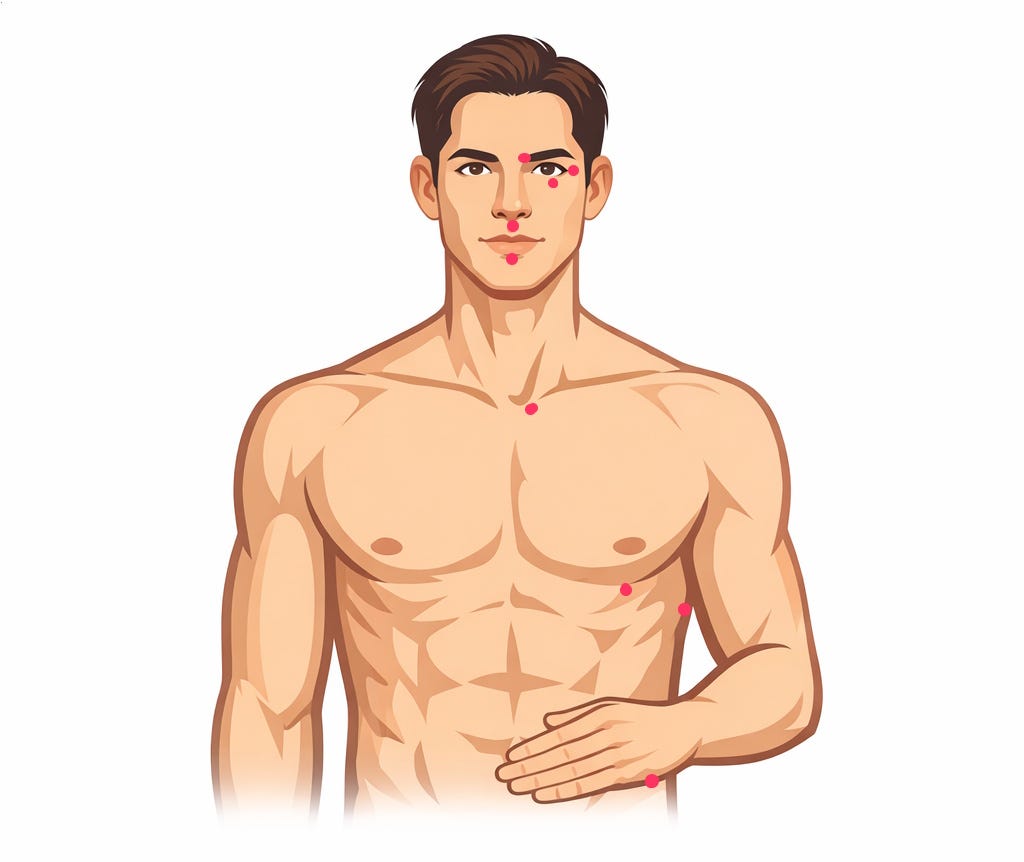
These points are, from top to bottom …
Inside corner of the eye
Just outside the outer edge of the eye
Just below the center of the eye
Between nose and upper lip
In the crease below lower lip
On the “bulb” of the collarbone
Just below the large chest muscle (this was in original system; often skipped now)
Under the arm, on the large latissimus dorsi muscle
On the outer edge of the palm (the “karate chop” point)
TIPS: Each of these points is slightly sensitive. If you tap in this area, you can feel where the point is located. For the points around the eye, you’re not tapping on the soft tissue surrounding your eye, but on the edge of the bony opening around your eye. You tap repeatedly and gently at and around the point; so if you don’t get exactly on the point it still works fine.
(1) Choosing a problem
You can do this for yourself, or you can do it for someone else. For simplicity, I’ll describe it as if you’re doing this for yourself.
A TIP: It’s easiest to learn this by working on mental or emotional issues first, and then when you’ve learned how to do that, then move on to physical issues. And if you’re just starting out, try working on some lighter-weight issues first. :)
Probably you already know some things where you’d like to have fewer problems, so pick one. (There are also ways to “search” for problems that may be buried or out of sight, like limiting beliefs or half-forgotten childhood issues or memories; I’ll cover some of those later in some follow-up articles, but for now just use some mental or emotional issue you’d like to be better.)
The issue you select might be an event, such as “an argument with my neighbor,” it could be an annoying habit like “always worrying about being late,” or it might be a situation like “feeling nervous driving on the freeway.”
For my example, let’s say I’m afraid of spiders. They make me feel … weird. I don’t like thinking about them, even.
OK. We got a problem.
(2) Finding a “descriptor” phrase
Now when you think about this problem, words will come to you. In my example, what comes to mind might be “afraid of spiders.” (If you’re working with someone else, you’d ask them to describe the issue, and just make note of the phrases they use while they’re telling you about it.)
I might think of one phrase, or I might think of several. Then, while doing the process, often additional phrases pop into your head. But we just choose one phrase to start with, the phrase that seems to sum up the problem. In this case: “afraid of spiders.”
(3) Performing a preliminary “set-up” for the clearing
The set-up statement in EFT has one job: To reduce internal resistance so the tapping can work more easily.
When you bring up an emotional issue, a part of you wants relief, but—through simple conditioning—another part of you often resists change. Because that part of you has learned to avoid this issue, because it always felt bad.
The resistance could come from thoughts or feelings such as:
“This is too painful to face.”
“I shouldn’t have to feel this way.”
“I don’t deserve to feel better.”
“This (unpleasant) emotion is keeping me safe.”
And so, in order to set aside this internal, automatic resistance, we first address this resistance by (a) acknowledging that this problem exists, and (b) granting ourselves the permission to proceed. We use a format like this:
“Even though I have this problem with (spiders/driving on the freeway/Aunt Mildred), I totally love and accept myself.”
By acknowledging the problem, and affirming that we still like ourself even if we have this problem, it loosens the resistance to the process, and the resistance to changing the problem. This may sound a little woo-woo, but it does seem to make the process go faster and easier.
Now, there’s another part to just saying the affirmation. While making the affirmation, at the same time, you rub on a special tapping point, which does the stuck-meridian or endorphin-releasing thing, and this “mini-tapping/rubbing” further weakens the resistance and boosts the affirmation’s acceptance-and-relaxation effect.
For the special tapping point, choose either the “karate chop” point on the outer edge of your hand, or what’s called the “sore spot” which is a point which is somewhat tender. To find this tender spot, move your fingers to the base of your throat to that soft unprotected part, and you feel the bone just beneath. Then move fingers down about 10 centimeters (4-5 inches), then 10 centimeters either left or right. When you press on that spot it feels “sore.” Rub on that, or the edge of your hand, while doing the affirmation. Sorry if it sounds woo-woo, but there it is. It works best this way.
(4) Tapping on the EFT points
Now what we’re going to do here is really just this:
We say the describing phrase, which slightly triggers the emotion
We tap on the points, which causes the emotion to grow weaker and weaker, and causes you to feel more and more comfortable, and then—as we continue—you feel better and better. In addition, it may often trigger realizations, unlock earlier memories, new awareness, and sometimes very pleasant feelings.
In addition, as we repeat the descriptor phrase and tap on the points, very often, new and additional phrases just pop up, because the stuff that was hiding them is clearing away. And so, these are new descriptor phrases, and we just keep tapping but working on these newly uncovered descriptor phrases as well. And similarly, we may discover that we uncover new, related issues. For my example, after tapping on “afraid of spiders” I might suddenly realize that “a spider running along the wall” is even creepier. So I keep tapping, and start using the new phrase.
This system is quite benign because the “client,” in this case, “you,” are setting your own gradient. You choose somewhat lightweight things to learn the process, and you’re choosing the trigger phrases. As you clear stuff away, deeper feelings may emerge, but they naturally open up, on a gradient, and it’s pretty easy to handle.
As you do this, and the issue is fading away, then certain “good indicators” will appear. These include things such as (a) a lighting of spirit, of the body, or even laughter; (b) an increase of energy; (c) a general issue like “low self-esteem” may mutate into a specific incident in the past, with greater clarity, and perhaps new realizations. You may notice yourself yawning; it’s odd, but this “good indicator” seems to often accompany the dissolving of the problem. And sometimes you get new insight which seems to have absolutely no connection with the issue; take the gift. Enjoy it!
When it’s complete; it’s complete. That means it’s time to stop the process.
There are some issues that can return in a new form later. Such as my clearing “afraid of spiders” and “spider running along a wall,” and then at some later time, I realize that “spider hiding in my underwear drawer!” And so you just run that one. :)
.
⭐ EFT Tapping: A Simple, Beginner‑Friendly Guide ⭐
Summary: EFT (Emotional Freedom Techniques) is a gentle mind‑body method that helps calm emotional intensity by tapping on specific acupressure points. You don’t need any special belief, skill, or background—just your fingertips and a willingness to try it. Here’s the simplest way to get started …
1. Pick one specific issue
Choose a single feeling, memory, or body sensation that’s bothering you right now. Keep it simple and concrete—“tightness in my chest,” “irritation from that conversation,” “fear of spiders,” “argument with Larry.” Rate how strong it feels from 0–10. This will provide a before‑and‑after sense of change.
2. Do the Setup
Rub either the Sore Spot (4” below collarbone; 4” from body’s centerline) or the Karate Chop point (the outer edge of your hand) with your fingers. While rubbing, say this three times:
“Even though I have this [problem], I can accept how I feel.”
You don’t need to believe it. It simply helps your system relax for the tapping to work better.
3. Choose a short reminder phrase
Pick a few words that describe the issue—“this tension,” “this fear,” “argument with Larry,” “worrying about the test.” You repeat this phrase at each tapping point to keep your mind gently connected to what you’re clearing.
4. Tap through the points
Tap each point 5–10 times, while repeating your reminder phrase:
Eyebrow: Start of the eyebrow, near the bridge of the nose
Side of Eye: On the bone at the outer corner of the eye
Under Eye: On the bone directly below the pupil
Under Nose: Between the nose and upper lip
Chin: The crease between the lower lip and chin
Collarbone: Just below the notch at the base of the throat
Under Arm: About four inches below the armpit
Outer edge of hand: The “Karate Chop” point
Tap gently—enough to feel it, not enough to hurt.
5. Check your number
Pause, breathe, and rate the intensity again. If it’s lower but not gone, do another round using the same phrase. If new thoughts, memories, or yawning appears, that’s normal. If new descriptor phrases arise—just treat the new phrases to new tapping rounds.
6. Continue until it softens
Most people feel a shift within a few rounds: emotion lightens, the body relaxes, or the issue feels less “charged.” When your number drops to 0–2, you’ve cleared that layer. If a new variation appears later (like “spider on the wall” becoming “spider in the underwear drawer”), just tap on that new image/phrase too.
Tips and Troubleshooting
(Very likely, you can skip this section, if you wish. Try the simple method given above. You’ll probably have good results right from the get-go. :) But if you wish, here’s some additional information about tweaking this or that.)
Go with one specific issue. If you choose something broad or vague (“my life is too stressful”), this doesn’t pull up a specific problem, so there’s no specific problem in focus to be cleared away. Narrow it down to one specific event, one specific situation, one specific person, one specific sensation.
Many problems have layers. If it’s not clearing quickly, ask yourself, “What part of this is bothering me the most?” Usually this focuses down to something more specific, and you get a new and crisper descriptor phrase.
Feel free to change the setup wording. If it’s too strong or too weak, change it to feel more “correct.” Examples: “Even though a part of me feels XYZ,” or “Even though I don’t like feeling XYZ.” or “Even though there’s this XYZ.”
You can also change the “I accept” part. Examples: “I can accept myself,” “I totally love myself,” “I have a wonderful life anyway.” Whatever feels a comfortable way to accept your life and yourself. (Even though that problem.)If it’s troublesome focusing on the emotion or it seems stuck, try focusing upon the physical attributes, such as “tight shoulders,” “dry mouth,” “heaviness,” or “pressure in my XYZ.” Tap on the body sensation instead of the emotion.
If it seems too heavy or it feels overwhelming, try softer language: “This discomfort,” “this awkward feeling,” “this thing that happened.” This inserts a bit more distance between you and it, which lightens its impact on you, and allows you to relax into the tapping process better, which clears the issue faster.
Having a new memory, emotion, or body sensation pop up is a good sign. That’s your body/mind showing you the next layer. Tap on that one. This can happen more than once. It’s not common, but you can unearth several layers. A bonus!
If the going begins to feel labored, then either the issue is complex or tied to something deeper. So switch to a smaller, easier part of the issue. (Or tap on the frustration if need be.)
OR … if you’ve actually already fixed it, and didn’t check your rating 0-10 (so as to stop because it was done), you can drive yourself into grinding because it’s already complet. This gets sluggish. Just tap the feeling of sluggish, it should lighten quickly, and you’re done!Watch for good indicators: Yawning as charge (stuck emotion) blows off. Loosening of the body, shifting your posture, sudden deeper breathing, a lightness of spirit, new awarenesses or cognitions. These items signal that you’re probably done. Check your 0-10. The problem may already have vanished. :)
Summary: How to know you’re done
The intensity-rating number drops to 0-2. This round is complete.
The issue seems distant, fuzzy, or unimportant. You remember, but no big deal.
Your body relaxes. Often stuck emotions hold the body in stuck positions, and when the emotions relax, the body relaxes.
You wonder why the thing bothered you so much.
No new aspects pop up. You’ve cleared the layer you were working on.
You simply “feel done.” This is actually quite reliable.
Helping someone else? How to uncover the problem and the phrases …
If you’re helping someone else with this technique, they’ll usually tell you what’s bothering them, and if you listen to their language, the phrases will just leap out to your awareness.
And then you can lead them through the set-up, and the tapping. If you tap on their body, that’s awkward and distracting, so you just sit across from them and you say the trigger phrases (and have them repeat them), and you tap on your own body, and they mirror you. In this way you lead them smoothly with very little “teaching” required.
But, while they’re discussing the issue, if they’re vague, stumbling around, going all over the place, or it’s just not clear, here are some gentle ways to help them focus, and (for you) to uncover the specific issue in the problem, and then to turn up some useful phrases that will gently connect them to the problem during the tapping process.
This issue … what seems to be the main uncomfortable part?
Could you describe, just a bit more, how it seems to you, or how it feels?
If you could look at it from one side or the other, are there any other parts that figure into the problem?
Something along those lines should be enough, and you can always say, “Could you say more about that?” (Of course, don’t sit there asking them endless questions or it will give them a brand-new issue … you!)
Now if you help someone with a few rounds of tapping on an issue, and they have a nice release, good indicators, observable improvement—and they feel they’ve got some good from it—then what you do next is to STOP.
Validate their good work, maybe compliment their abilities or openness, and that’s it.
Using EFT as an ongoing self-therapy
In these examples, we’ve been talking about this method as reactive, as something to be used after some problem arises.
But of course, a person could use this actively as well. For example, you could use this for self-improvement by seeking items within your psyche and then processing them. Or, if you’ve used this—or some other technique—and repaired or improved some problem, a person could elect to go a-digging, to see what else might be in there.
In other words, you could go looking for trouble. :)
In some cases, this is a pretty smart idea. So, if you’re wanting to delve a bit deeper., here are some example questions you could use to uncover deeper layers …
When was the first time or some other time you remember feeling a similar feeling?
Does this issue lead you to other thoughts as well?
If there were possibly some other issue behind this one, what do you think it might be?
If you were to live your life over again, is there any event you’d prefer never to experience, or some person you’d really like to never meet?
If something comes to mind—even if it seems unconnected—that IS the thing. Just focus on it quietly, patiently, and let it clarify. Then, whether it seems to make sense or not, that is your answer, so process it.
If you feel uncertain, take a guess. Our guesses are often surprisingly useful, even when they seem quite “off the wall.”
One more thing: If you keep a dream journal, or if you remember a dream, then, if you pause to think about it, nearly always the strange situation of the dream is paired with one or more feelings. Focus on the feeling or feelings in the dream; just hold onto them in your mind, and then allow a describing phrase to emerge. Usually, it will come rather easily. You can then tap on that feeling. And this in turn will often turn up earlier actual life-incidents, or earlier times you felt that feeling, and sometimes it will also make sense of some of the visual images in your dream. :)
Further Adventures …
To further explore this mind-palace, many specific applications were created by Gary Craig (and others) to focus on specific issues, such as:
PTSD and trauma
Fear of public speaking
Overeating
Pain management
Obsessive-Compulsive disorders
Phobias
Performance issues
Physical symptoms
Gary Craig’s original trainings and videos are still available, still free, and still excellent. The Further Research links below provide access to his materials, other useful books on the subject, and to related articles here on Live Long, Prosper, and Find Peace.
.
Some good, kind words … a bene-diction …
This elegant little system/discipline/method is a tool placed into our hands, a gift. With such tools we create reality, our lives, and happiness.
May your life further blossom into delight, and happy tapping for you, as you travel into the dawning time.
.
For further research
Emotional Freedom Technique (EFT) …
The Technique: Text (How to Do EFT) with demo video
More: The Gold Standard EFT Tapping Tutorial (comprehensive manual)
Even More: The Palace of Possibilities home page
The EFT Manual — by Dawson Church
Mind to Matter: How Your Brain Creates Material Reality — by Dawson Church
Gwynneth Moss’s EFTHelps website … Gwynneth is a worldwide EFT expert. 5 Stars!
Gwynneth Moss’s The EFT Guild … Both her basic and advanced seminars are super!
Focusing: Another tool for self-knowledge and healing:
Focusing: How to Gain Direct Access to Your Body’s Knowledge — by Eugene Gendlin
The Power of Focusing: for Emotional Self-Healing — by Ann Weiser Cornell
The Radical Acceptance of Everything — by Ann Weiser Cornell
The Focusing method is not as quick and easy to use as EFT; however, it is startlingly powerful, for uncovering the hidden, mysterious truths your body knows. Ms. Cornell’s Power of Focusing book is probably the most accessible entry point for Gendlin’s Focusing method. And her teaching seminars are dynamite!
Other articles you may find useful
How to Talk with your Unconscious Mind
Twenty-Second Tuneup Makes You Feel Good
Instant Meditation; Hold It at the Top
Four Ways to Demolish Stage Fright
How to stay in touch, get more, & have fun …
- Subscribe to “Live Long, Prosper, Find Peace” to get new posts directly in your inbox. These articles give actionable, simple methods to feel good, live longer. and find peace—providing surprisingly simple ways to do things that most people believe difficult.
- Join me on Social Media for daily posts, cartoons, and artwork. (LinkedIn, Instagram, Facebook, WhatsApp, Tiktok, X, Snapchat, Telegram, and YouTube …)
- Join me on Adventures of Bloggard for micro-stories, short quick-reads that people find funny, thought-provoking, or poignant.
- Share comment on any of these — I love hearing from you!
- And if you enjoy what you read, please consider sharing it with a friend.
Thank you for being here. Let’s explore, learn, and grow together! —Arthur Cronos
The four classifications of articles —
Full System — complete, A-to-Z solution
Quick Method — fast, usable technique
Lifecraft Tool — practical everyday fix
Reality Shift — perspective that changes outcomes
Disclaimer: Nothing on this site provides legal, medical, business, or other professional advice. All information is shared in good faith and believed to be true at time of publication, but mistakes happen and facts change, so it may not be current, complete, or accurate. Use your own judgment, and you agree that author and website are not liable for any loss or harm resulting from its use, including any small-to-moderate apocalypse.
All contents of the “Live Long, Prosper, and Find Peace” publication © 2026 by Arthur Cronos, Mount Shasta CA. All rights reserved except any expressly granted in this article.
Thank you for having the generosity of spirit to share Gary’s original teaching, which was always free.
Thank you so much for sharing this. I actually included a brief section on EFT in my meditation book because I thought it could be helpful for anxiety, but I never even thought about using it myself for fear of water! Funny enough, I’m getting ready to go to Cancun at the end of the month and have been thinking how much I’d love to go snorkeling… while also feeling that fear kick in at the same time. Reading this really gave me something to think about, and I’m going to try it. Thank you again for thinking of me and sharing the article. 😊