
The Tyranny of the Taste-Bud Trap ...
How the corporate food-cartel enslaves you with evolution's trick!

Classification … LONGEVITY > #NUTRITION, #HOWITWORKS, #HEALTH, #WEIGHTLOSS … (FULL SYSTEM) (REALITY SHIFT)
Overview … Once upon a time, there was something we call evolution. Really, of course, there’s no thing there at all. We’ve just stuck a name on a process that happened over a period of time. Like the way we’ve identify certain years as the “Jurassic Period.” It’s just a handy label. But how evolution actually works is super-useful, if you want to escape a modern-day, purposely engineered trap, that will make you feel miserable and trash your lifespan …
How Evolution Works: It’s Simple
The essence of evolution is that we creatures have random mutations in our bodies over time. Some of these random changes might be beneficial to our survival, and some might end us early. In some cases, being larger might be an advantage, and in other cases, being smaller might be an advantage. Gorillas took advantage of being larger, and mice took advantage of being smaller. Each found an advantage.
And those that mutated into an advantage survived longer … and left more progeny.
Doesn’t that make sense? The dead ones have fewer kids after becoming dead.
Now, very simply put, reproduction of humans and other animals is that the child’s body is cloned and built from the structure of the parents’ bodies. And when the humans are duplicating their own bodies into the child’s body, those mutations are passed along into the child’s body. And the child of mutated higher-survival parents has higher survival as well, so the child in turn, creates more progeny with those mutations.
Now, here’s the key point. We are the offspring of humans who had certain random changes that mutated them. We have been given the mutations that aid survival.
What Kinds of Things Does the “Evolution” Process Pass Down?
There are many things, but some simple examples:
Humans (and many creatures) learn quickly if something’s really hot, so when you touch the burner on your stove, you move your hand real fast. You don’t think about it. That reaction has been built into your body. By the evolution process.
If something is freezing cold, like an iceberg or a winter lake, unless you’ve got a darn good reason, you don’t go jumping in there. You stick a toe in, you say “no thank you,” because our ancestors who avoided freezing themselves left offspring and that’s us.
These traits are now built into our bodies, many below the level of awareness—automatic reactions—because they’re now hardwired into the nervous system.
In this way, we can see that heat and cold was built in, and sexual attraction was built in. The guys attracted to women expended effort and left more offspring.
In the same way, we have learned to use our senses to avoid stuff that’s not good for us. We’ve have learned that rotten food and poop and other “bad smelling” things aren’t good for us, and we’re not attracted to consume them. It’s automatic, now.
And other things are dreadful to your sense of taste. These help us avoid poisons, toxic acids, food gone bad. This automatic-reaction system isn’t a hundred percent accurate, but it’s pretty good.
Along the same lines, our nose and our taste buds were used to determine what foods or what items could be eaten for sustenance. The scent of many food items is attractive. A steak sizzling away in a skillet, for example. Or a rich curry dish.
But a Dangerous Group Became Involved
Now if evolution was still triggering your reactions to foods and you were living in the time of your great-grandparents, anywhere in the world, wherever your great-grandparents were, then at that time what did people eat? Well people ate things that had been grown and they ate creatures like animals, fish, and a few insect-like creatures such as shrimp and crab.
In the earliest days, humans ate somewhat like apes do today, as they wandered around finding what they could. Plants, leaves, roots, nuts, fruits in season, and insects, grubs, small animals that could be killed and eaten.
Now, in our timeline, as agriculture developed and we began to learn to take some control over what grew, it was great in some ways. It meant that people could begin to control what grew and so they could have food more often because they had created the garden. Same for raising animals and slaughtering them later. More control. More available food. That was just swell in many ways, and it was part of what we call civilization, which means a tribe that’s large enough to have a few politicians and priests in there doing what they do.
But here’s a real key point: Your great-grandparents, only had certain things available. And their foodstuffs, they were “single ingredients.”
Now, they go into a pub or a place where someone was cooking the food, potatoes, beans, and roast chicken. These early places cooked the same way that people did in their homes.
Here’s one commonality … the food was prepared from single ingredients.
Now you can quibble about this, you say, “What about bread?” Well, you can make bread with flour and water and a little bit of salt, but that’s still basically a single ingredient. Like if you cooked a steak, you might salt it. You might cook it in some oil or fat; but it’s basically a single ingredient.
Now, at some point, people got the idea of cooking things from several ingredients. It’s soup. And many, many things are derivative of soup; casseroles are not that different from soup. It’s still a mélange of different ingredients, but each of these ingredients were single food items.
As time went on, some entrepreneur said, “What if we could sell corn to these folks?” But not corn on the cob because we can only do seasonally. “What if we could grow the corn, cook the corn, and put it in a can?”
Farm families were already keeping summer produce through the winter months using jars and cans. My grandparents had a cellar with hundreds of dusty jars and mysterious cans. So it wasn’t a big step for entrepreneurs to get into the act.
And this was profitable, and these companies grew and became large corporations.
And then frozen foods came out. After the Rural Electrification Act of 1940, when farms got electricity, the market for refrigeration took off. And it became possible for corporations to prep something, freeze it and ship it to grocery stores that had freezers to sell the product. The first I recall was Bird’s Eye frozen foods, and it wasn’t too long after that when the first “TV Dinners” showed up from the Swanson company.
This corresponded with a time when our middle class was growing. We had strong unions who could negotiate wages, both political parties had pro-worker and pro-union platforms. (The Republican Party platform of 1956 sounds like what we think of as the Democratic Party.) Taxes were high on big companies, low on normal folks. These market forces combined to make “convenience” a viable element in selling.
You could be a Thoroughly Modern Manfred, buy a TV Dinner, and eat it in front of your brand-new Television set, on a fold-up TV-table just for that purpose! Oh, my!
And the Corporations were Off to the Races!
Well, from there, corporate interests began to take a larger interest. They became more involved with large agriculture and meatpacking companies. They bought large quantities, then cooked things, put them in cans and jars and frozen packages, and suddenly, these “prepped” items began taking up more floorspace in the grocery stores.
Somewhere along the line, corporations noticed that they baked and packaged bread, but people want it real soft. So, they tinkered and learned that if they added this and we added that—basically chemicals, not actual food—it made the bread softer. They didn’t think that feeding us chemicals could hurt us, because they made some and Jerry in the company ate it and it he was still OK. And the bread was softer.
And then someone said, “But sometimes our food goes bad, and we have to take it back. But if we added this and that, it would stay on the shelf longer, and people would still buy it. We wouldn’t have to take it back; we’d make more money.” They did that, and it worked, and no poisoned multitudes appeared, so that became normal.
This went on and on and on. And then now we come to the point that someone in the corporations had a bright idea: “Wait a minute, how can we make this tastier?” Or maybe they even said, “Wait a minute, how can we make this more addictive?”
Enter Evolution’s Quirks …
Some of the things that make food tastier, we already know. Salt, sugar, fats like butter. Mainstays of cookery. Because evolution has built into all of us a certain desire for salt, especially if you’re working physically very hard. If your body runs low on salt, man, you really, really want to eat some salt. And so they begin to add salt because salt is an automatic pleasure trigger in what we eat.
And then came sugar. Perhaps because of Hawaii, we had all the sugar a person could want. And take a look at past per-person sugar-consumption figures:
1800-1850, 2-7 pounds of sugar per year
1850-1900, 7-22 pounds of sugar per year
1900-1950, 22-49 pounds of sugar per year (Rural electricity)
1950-2030, 49-60 pounds of sugar per year (TV dinners and beyond)
A Generation of Addictive-Food Junkies
The corporate plan has worked really well. For them.
Monosodium Glutamate was added early. By the 1930’s, it was already widely used in canned soups and seasoning mixes, and as frozen foods expanded from the 1930s-1940s, MSG was adapted as a standard “flavor enhancer.” But of course, what it actually does in the body is: It triggers some of the flavor sensors in your tongue, increasing the “perception” of savory flavor. This in turn triggers over-eating and weight gain. (In the laboratory, when scientists need fat rats for an experiment, they just feed them MSG and the rats get fat real quick. Just like we do.)
In other words, it INTERFERES with the normal functioning of your body.
And that makes more money for the corporations, and the side effect is a growing epidemic of obesity. From measurements of 15,000 subjects, here’s the average young American (ages 21-25) in 1943, before the corporate hijacking of the “food” industry had become complete …
The Average American Man in 1943, age 21-25 …

The Average American Woman in 1943, age 21-25 …

(These photos from Cleveland Health Museum, after creation by the 1943 work of obstetrician-gynecologist Robert Latou Dickinson, who did the study of 15,000 subjects, obtaining the average measurements, collaborating with artist Abram Belskie who created the statues to match the average measurements.)
The nearest match today of this study is the NHANES study of age braket 20-29 years of age. The average anthromorphic data in that study says:
Average weight. Men ~188.6 lb, Women ~161–166 lb
Average height. Men ~69 in (5’9”), Women ~64 in (5’4”)
Average waist. Men ~40.6 in, Women ~36–37
I asked the same AI to create an image, with bathing suits, from these measurements. I don’t think this is accurate. The models in the image look fatter than what I imagine from the height and weight given above, but perhaps it’s accurate. The guy looks about right for 180 pounds, but a 5’ 4” woman of 160# would seem a little less rotund, though still quite plump. But accurate or not, here’s the AI’s photo …
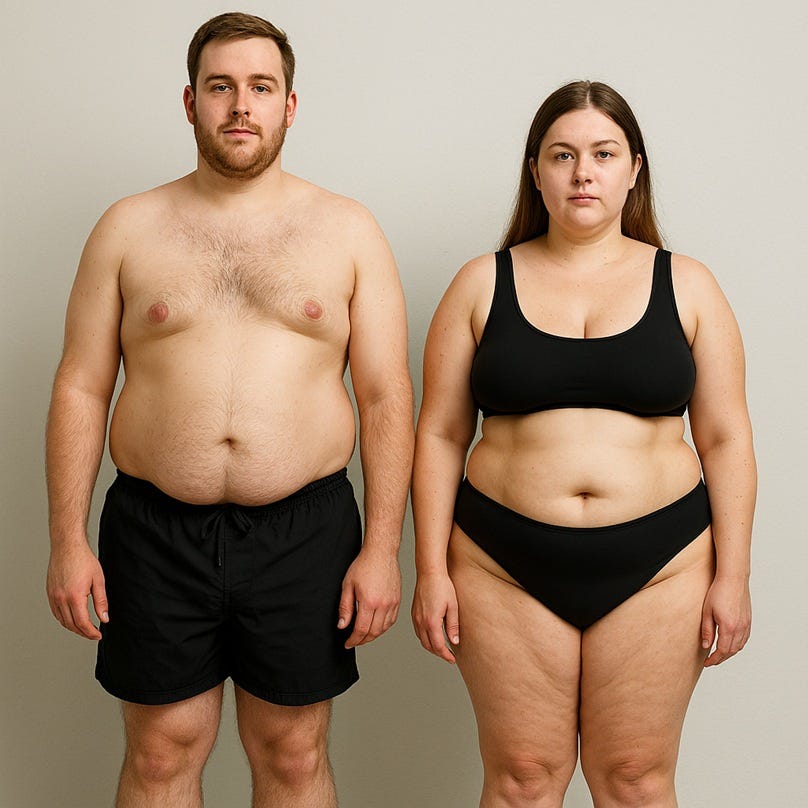
Regardless of the accuracy of the AI rendering, you know from your own experience, that the average 25-year-old young people more resemble this second image than they resemble the average young people in Dr. Dickenson’s 1943 study.
This is primarily the result of the changes in the “food” supply, due to the addition of addictive, body-altering substances like MSG, excess sugar, excess salt, and excess fats. (Especially since the corporations have changed from natural fats to synthetic, manufactured fats commonly called seed oils, which inflame the body systems, and produce another entire cascade of health- and weight-damaging effects.)
But You Can Escape the Trap
First, full disclosure. You cannot continue eating what’s called “convenience” foods. Because now the best available data suggests that well over half the things sold in U.S. grocery stores today contain sugar, seed oils, emulsifiers, preservatives, or other technical additives … especially the center aisles. (2023 study from Journal of the Academy of Nutrition and Dietetics found 60% of American foods contain at least one technical food additive. Another study in BMJ Open showed that ultra-processed foods account for nearly 90% of added sugar intake in the U.S. diet.)
What this means, if you want to escape the trap …
You can’t purchase prepared food, most frozen foods, sauces, soups, etc.
You’ll need to purchase “single-ingredient” foods, usually found around the outside aisles of the store: Meat, chicken, fish, eggs. Produce. Spices.
You’ll want to avoid fast-foods, and restaurants in general, because they use the same poisoned concoctions, mixes, seed oils, and chemicals to prepare dishes
You’ll want to prepare most of your own meals, because you cannot purchase foods prepared by others without incurring the corporate additions
Is This Change Difficult?
Yes. And no.
You’ll be going back to the way your great grandparents prepared and ate food. Here are some of the things they did differently:
They didn’t necessarily eat three meals a day. This was a factory-worker innovation that was added after 1800. Before 1800, two meals a day was standard. Among English colonialists, for example, breakfast was not universal, and the main meal (“dinner”) was eaten late morning or midday. But industrialization in the mid-1800’s required regular, predictable meal times. Factory workers needed a morning meal before longs shifts, and breakfast became essential. But once upon a time, what we now call “intermittent” fasting was the general rule. :)
Breakfast marketing from Kellogg’s and Post cereals boosted breakfast even more toward the late-1800’s. By early 1900’s, three meals is the American standard, but there is NOTHING about 3 meals which is healthier or more convenient. In fact, it’s detrimental to eat all day long, as the body cannot do its optimum recovery.You cannot do a full-scale fancy meal every time. Raw snacks like fruit, salads, and leftovers become attractive, because they’re quick. Prepping large amounts that can provide several meals works well. Soups, and turning one meal into the next meal’s soups … all these college-kid tricks work just fine. And save time, too.
And when you GET FREE of the addictive substances, much of your drive to eat, eat, eat all day long … will go away.
What About Your Taste Buds? (that Darned Evolution, Again)
It’s not popular these days, but back in the late 1970’s, a diet book was making the rounds. The diet was called “the Macy’s diet,” because it had gained popularity at the Macy’s store in New York. I recall little about how that diet worked, but it had one thing I found interesting …
The first two weeks, this approach had you eating, for your first meal of the day, one half of a green apple (less sweet than some of the red ones), and a half-cup of plain yogurt. While most yogurt these days is suspect, the interesting thing was that, by doing this for two weeks … you changed your taste buds!
It really did!
This made me realize that, while we tend to be somewhat addicted to our “habits,” what we perceive as flavorful is, in fact, programable. In other words, if you change what you eat, your taste buds will also change. It doesn’t take long, so a change is not something to be feared.
Will you have to give up some stuff your hijacked tastebuds thinks you like? Maybe. But you can find perfectly healthy things, and once you get free of the junk food with additives, you will discover that many plain and simple foods become delicious!
Another Powerful Trick to Make Change Easier
Like many people, I’d let myself grow heavier and heavier as I grew older, until finally it was just stupid. And though I’d fiddled with this or that “diet” over the years, I started reading more widely, and—rather by accident, I think—I stumbled into a POWERFUL TRICK that made it become surprisingly easy to change.
The secret is in the squence.
This sequence is what made all the difference …
Get OFF the addictive foods first. Firstly, stop eating fast-converting carbs (flour, breads, any pastries or sweets, most potatoes, cooked carrots, honey, and even fake or substitute sweeteners, as many of them cause the same problem through devious methods. To get OFF the addictive fast-carbs, start by TANKING UP on keto-style foods. By TANK UP, I mean overeat like a pig if you want, of meats, eggs, leafy veggies, sulphur veggies (cauliflower, broccoli, cabbage, etc.), all salads. Eat veggie soups, meat soups, seafood soups. Eat broth, coffee, tea, cream’s fine, just no sweeteners. TANK UP. After a while you won’t want to tank up, but you’ll be free of the “gobbles” … that insideous, “gotta eat, eat, eat” all day impulse that is triggered by your body’s continual reliance on carbs for food.
Get OFF the seed oils. No more canola, soybean, safflower, sunflower, corn oil, etc. Use only butter, ghee, coconut oil, true virgin olive oil, tallow (beef fat), or lard (pork or bacon fat). Your body can burn those, but the seed oils inflame tissues throughout the body and also lead to sickness, overweight, and the gobbles.
As soon as you’ve beaten your carb addiction, change to “intermittent fasting,” meaning you chose a window of time, like 6 hours each day or 8 or even 10 if you must. And you ONLY eat during those hours. Your body can then begin to recover from the constant gorging, and it will feel better, you’ll have more energy, and you’ll sleep better.
For me, I then learned how to fast now and then. The body is designed to do it, and once you’re no longer carb-addicted, and no longer in the habit of eating all day long, it’s actually rather easy. I found it effortless at this point, not particularly hungry, and my energy was as good as on eating days. But this article is about escaping the addiction that corporations have instilled in you, by manipulating your built-in food “preferences” that kept people safe 100,000 years ago. They did this to get you addicted, and to sell you cheaper ingredients, and to get your money. None of it was ever about being good for you. Remember: If something needs an advertisement on television, it’s crap for your body’s health.
That’s it.
This is WHY your body has a weakness for salt and sugar and fast-converting carbs that become sugar. This is HOW corporate interests created “food-like” products containing emulsifiers, preservatives, and intentionally addictive substances to trick your body and keep you hooked so you’d keep paying them money while your health was being damaged. This is HOW you can escape the slavery of corporate “food” addiction. This is HOW you can regain your health, and stop letting them use your own body’s evolutionary oddities to keep you enslaved.
So who’s the boss? You, or Evolution? You, or the fake-food cartel?
I found this information useful. It helped get me OFF the addictive (yet poisonous) fake foods that surround us, filling 95% of every “grocery” store in America.
I hope you might find it useful, as well.
How to stay in touch, get more, & have fun …
- Subscribe to “Live Long, Prosper, Find Peace” to get new posts directly in your inbox. These articles give actionable, simple methods to feel good, live longer. and find peace—providing surprisingly simple ways to do things that most people believe difficult.
- Join me on Social Media for daily posts, cartoons, and artwork. (LinkedIn, Instagram, Facebook, WhatsApp, Tiktok, X, Snapchat, Telegram, and YouTube …)
- Join me on Adventures of Bloggard for micro-stories, short quick-reads that people find funny, thought-provoking, or poignant.
- Share comment on any of these — I love hearing from you!
- And if you enjoy what you read, please consider sharing it with a friend.
Thank you for being here. Let’s explore, learn, and grow together! —Arthur Cronos
The four classifications of articles —
Full System — complete, A-to-Z solution
Quick Method — fast, usable technique
Lifecraft Tool — practical everyday fix
Reality Shift — perspective that changes outcomes
Disclaimer: All information shared in good faith and believed to be true at time of publication, but mistakes happen and facts change, so it may not be current, complete, or accurate. Use your own judgment, and you agree that author and website are not liable for any loss or harm resulting from its use, including any small-to-moderate apocalypse.
All contents of the “Live Long, Prosper, and Find Peace” publication © 2026 by Arthur Cronos, Mount Shasta CA. All rights reserved except any expressly granted in this article.
This really resonated with me. I knew much of this already, but there’s something about reading it laid out like this again that brings a different kind of clarity. It’s a good reminder of how easily we drift without even noticing.
I stepped out of that “corporate food” cycle more than 5 years ago, and honestly, that’s been one of the most impactful shifts I’ve made. And the surprising part is how simple it actually is. Nothing extreme, nothing fancy… just eating real food consistently. The body does the rest.
What I’ve found most fascinating is exactly what you pointed to...your body starts to "know". After a period of eating clean, it becomes very clear when something is off. There’s a kind of immediate feedback… subtle at first, then unmistakable. Not from rules or restriction, but from awareness.
That, to me, is where it connects back to mindfulness. It’s not just about what we eat, but whether we’re actually listening.
And I loved this "But once upon a time, what we now call “intermittent” fasting was the general rule. :)" I do the "old time general rule" for years...If I eat proper clean food, I can't eat more than 2 meals a day... I will explode if I do :)
Really well written, and such an important reminder.
I actually have to thank you for a time way back, when you lived in the Marina, and invited me to dinner. You made a big salad, with some carrots and lots of things. I actually had never had a big salad like that. I've eaten them ever since, and now usually have 1-3 each week.
Also, you introduced me to grapefruit. As a kid I had them, but ... mom and grandmother would cut them in half, then slice down into each section, then sugar atop. So it was easy to eat, and sweet. But you just peeled a grapefruit and I'd never thought of that.
I have oranges and grapefruits about every other week or so.
Thanks!